Eighteen months after the cyber attack that halted its online fashion business, Marks & Spencer has put a final figure on the direct bill. In its interim results published on 4 November 2026, the group says incident costs will total about £134 million, once a further £2 million expected in the second half is booked.
The breakdown comes from M&S’s own accounts. £131.3 million was charged in the 2025/26 financial year, which ended on 28 March 2026, and £0.3 million of legal and advisory fees in the six months to 26 September 2026. These are system recovery, risk management and specialist advice costs, which M&S books as adjusting items, outside its adjusted profit. Insurance income of £100 million linked to the incident was recorded in the first half of 2025/26, this time inside adjusted profit.
Profit back, almost
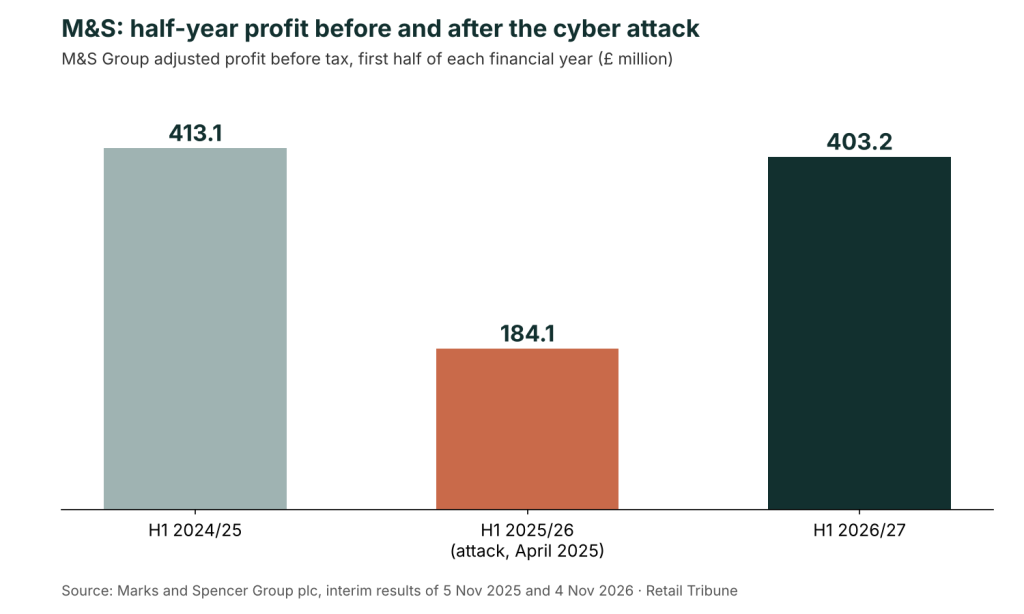
The direct costs are only part of the damage. Online orders, click and collect and in-store ordering were paused from late April 2025. In the first half of 2025/26, Fashion, Home & Beauty sales fell 16.4% and online sales in that division dropped 42.9%. Adjusted profit before tax went from £413.1 million to £184.1 million.
| M&S Group adjusted profit before tax, first half | £m |
|---|---|
| 2024/25 (before the attack) | 413.1 |
| 2025/26 (attack in April 2025) | 184.1 |
| 2026/27 | 403.2 |
This year’s £403.2 million is still £9.9 million, or 2.4%, below the pre-attack half (our calculation from the published figures). The gap can’t be pinned on the attack alone: M&S also cites cost increases and a hot summer that hit store sales. It does, however, name “the long-tail impact of the incident” as one reason for stock availability problems in fashion, where sales and profit stayed below 2024/25. The group adds that it continues to cooperate with the Information Commissioner’s Office and other regulators.
A sector that delegates the risk
Interviewees in the UK government’s Cyber Security Breaches Survey 2025/2026, published on 30 April 2026, mention “the big attacks in the retail sector” as a reason boards paid more attention. Its sector figures are not flattering for retail. Only 20% of retail and wholesale businesses have a board member responsible for cyber security, against 31% of businesses overall. And 37% had sought information or guidance on threats in the previous twelve months, against 44% overall. Across all businesses, phishing remains the most common attack, reported by 38%.
One limit: the survey covers businesses of every size, most of them small, and fieldwork ran from August to December 2025. It describes the base of the sector, not large listed retailers like M&S.
For the state of UK retail demand over the same period, see our piece on the BRC-KPMG Retail Sales Monitor for September 2026.
Sources
- Marks and Spencer Group plc, interim results for the 26 weeks ended 26 September 2026, 4 November 2026: corporate.marksandspencer.com
- Marks and Spencer Group plc, interim results for the 26 weeks ended 27 September 2025, 5 November 2025: corporate.marksandspencer.com
- Department for Science, Innovation and Technology and Home Office, Cyber Security Breaches Survey 2025/2026, 30 April 2026: gov.uk